
GPUs Are the New Headcount. Rent Is Up 143%
GPUs Are the New Headcount. Rent Is Up 143%
Every GPU that Andreessen Horowitz tracks costs more to rent than it did in January — even a chip from 2020. If you build on AI, the price of an hour of compute is now the number that matters.
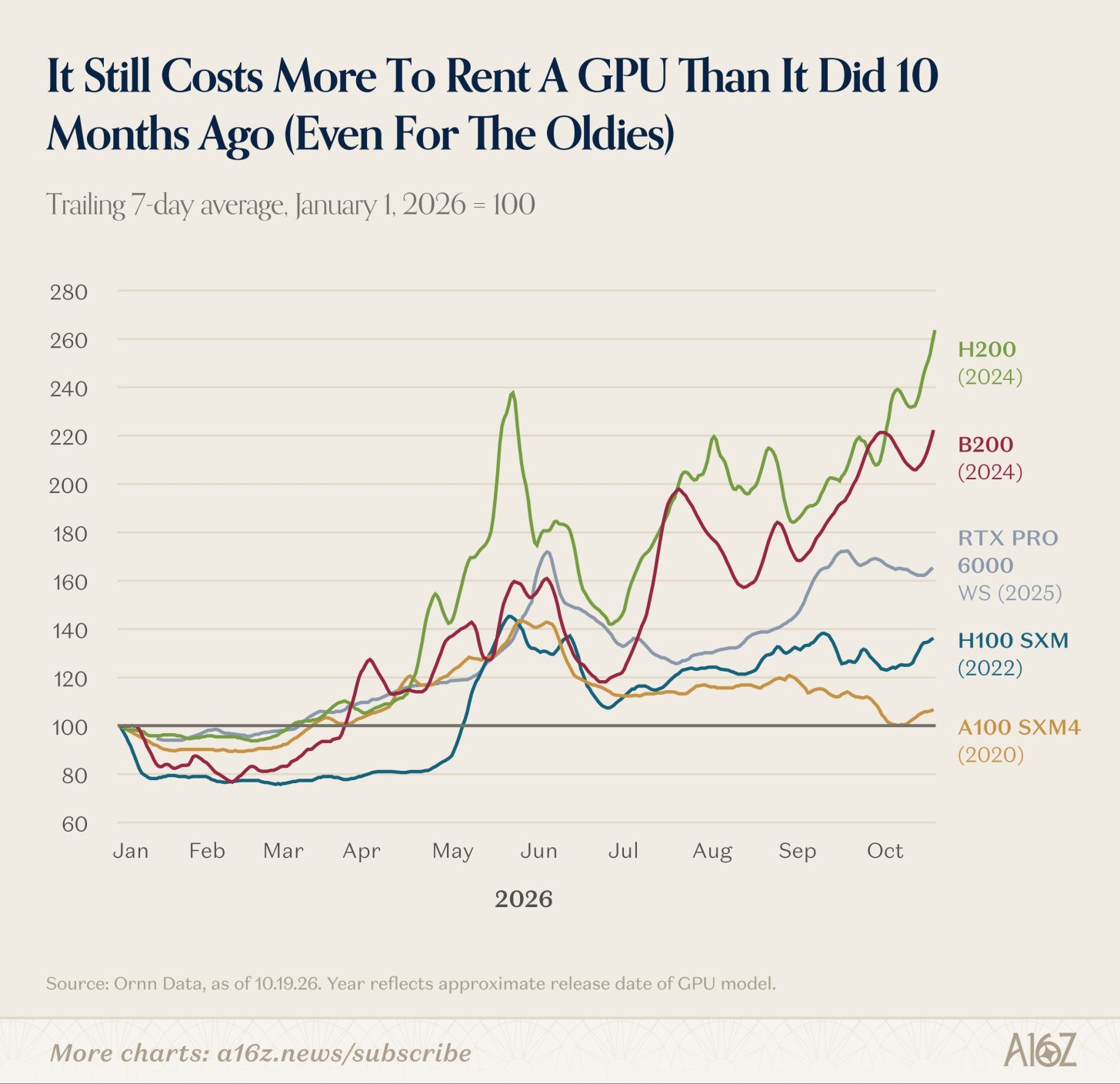
Every GPU that Andreessen Horowitz tracks costs more to rent today than it did in January. The biggest jump belongs to Nvidia's H200, up 143% — and even the A100, a chip from 2020, rents for more than it did at the start of the year.
The numbers come from a16z's Charts of the Week, built on rental data from Ornn Data and published October 23. They landed at a moment when the AI buildout's economics are the story itself: Elon Musk's quote-post of the a16z chart passed 1 million views within a day.
The rent went up on everything
According to Wccftech's reading of the a16z charts, the H200 is up 143% since January 1, the B200 up 111%, the RTX PRO 6000 up 73%, the H100 up 54%, and the A100 up 9%. Not one tracked model is down.
The timing matters. Most of these cards bottomed in the first quarter — the H100 and B200 fell roughly 23% below their January levels — then rebounded in April and May. A16z's Moses Sternstein ties the inflection to token demand on OpenRouter, the marketplace where people route prompts across models, taking off in the spring.
Then there's the stranger number. Measured against a straight-line six-year depreciation schedule — the assumption that a chip steadily loses value as it ages — current rental prices run 9% to 143% above where they "should" be. These chips are supposed to get cheaper to rent as they get older. This year, they got more expensive instead.
Cheaper tokens, pricier machines
This is the paradox at the heart of the buildout. AI keeps getting cheaper to use — token prices fall, models get more efficient — and the machines that run it keep getting pricier to rent. Cheaper intelligence doesn't shrink demand for compute. It grows it, because more people can afford to use more of it.
That's why a16z frames GPU capacity the way you'd frame hiring: the question isn't really the price of the chip, it's how much intelligence you want on staff. A GPU hour is becoming a unit of labour, not just a unit of hardware. And right now, that labour is getting more expensive.
What this costs you if you actually build
The a16z charts are market averages. What you actually pay depends on which card and which provider. Take Nvidia's B300, the current top-end Blackwell card with 288 GB of memory. Public price lists tracked by Telnyx put one on-demand B300 hour at $7.10 on Modal and $17.80 on AWS in October 2026 — the same card, a 2.5x spread.
The hourly rate is also only the floor of the bill. A rented card bills for every hour it's reserved to you, working or waiting. One B300 at $7.10 running around the clock costs about $5,183 a month before it serves a single token. Egress, storage, and interconnect charges stack on top.
Buying outright isn't obviously better. A single B300 runs $50,000 to $60,000, and it pays for itself against on-demand rent in roughly 4 to 12 months of 24/7 use — before power, cooling, and staff. Each card draws up to 1,400 watts and needs liquid cooling, so the real breakeven comes later than the simple math suggests.
The decision rule that falls out of all this is simple. Bursty work on an open-weight model? A per-token API bills nothing while the GPU sits idle, so start there. A training job that checkpoints often? Spot capacity runs about $3.75 an hour. Steady, predictable load? A long reservation drops the rate as low as $3.13. Buy a card only when the load is predictable and runs longer than a reservation term.
The catch in the chart
A16z itself flags the caveats, and they're worth hearing. These indices are imperfect proxies, and the older A100s and H100s spent long stretches of this year below the depreciation line before climbing back above it. A rental price measures what hardware earns today, under scarcity. It says nothing about what the hardware is worth when new supply finally arrives.
So don't read this as "GPUs only go up." Read it as: demand is outrunning supply right now, and the price of an hour of compute is the number to watch. When that number turns, it will tell you the buildout's mood before any earnings report does.
If you're building on AI, the practical move is boring: price the GPU hour before you pick the model. Check what a per-token API charges for the same job first, and only rent a card when the workload actually needs one. The models will keep getting cheaper. The machines, for now, aren't.
