Good Monthly Growth Rate for a Startup: 5 Benchmarks
Everyone quotes 15-20% a month, 5-7% a week, or T2D3, and rarely says where it came from or what it measured. Here are five benchmarks, each traced to its original source and put on the same monthly basis.
Saksham Dogra 6 min read
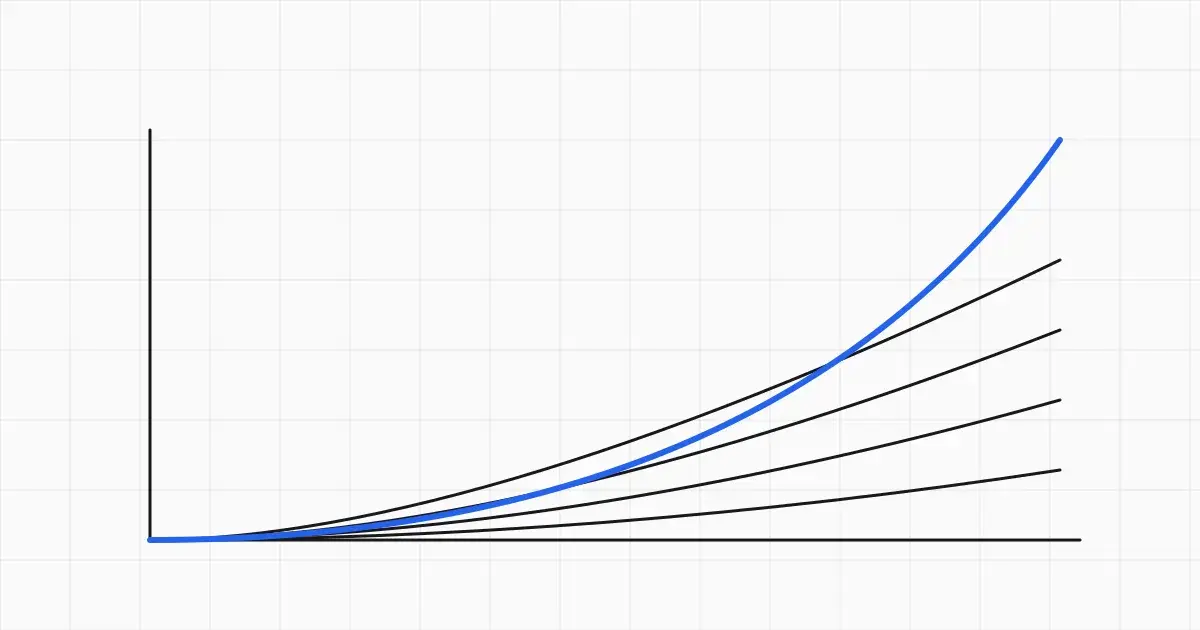
A good monthly growth rate for an early venture-backed startup is usually put at 15% to 20% in revenue, and the older benchmark from Y Combinator is 5% to 7% a week, which is about 24% to 34% a month. Both shrink fast as you scale: the T2D3 path implies roughly 10% a month at first and about 6% later, and the median private SaaS company grows about 1.7% a month. Each number below is traced to its original source, as of November 8, 2026.
The numbers look inconsistent because they measure different things: weekly versus monthly, startups in a three-month batch versus mature companies, and a hypothetical versus a survey. Put on the same monthly basis, they line up, and you can see which one fits you.
The 5 benchmarks on one monthly basis
| Benchmark | Stated rate | Same, per month | Who it was written for | Source |
|---|---|---|---|---|
| Paul Graham, “good” (2012) | 5% to 7% a week | about 23.5% to 34.1% | Y Combinator startups during the batch | paulgraham.com |
| Paul Graham, “exceptional” | 10% a week | about 51.1% | Same | paulgraham.com |
| Tomasz Tunguz (2014) | 15% to 20% a month | 15% to 20% | Post-seed, pre-Series A SaaS | tomtunguz.com |
| T2D3, Neeraj Agrawal (2015) | 3x, then 2x a year | about 9.6%, then about 5.9% | Enterprise SaaS from $2M ARR | TechCrunch |
| SaaS Capital median (2026) | 22% a year | about 1.7% | All private B2B SaaS companies | saas-capital.com |
Conversions are ours: monthly = (1 + weekly)^(52/12) - 1 for the weekly rows, and (1 + annual)^(1/12) - 1 for the annual rows.
Is 15% to 20% a month the “right” benchmark?
It is a reasonable rule of thumb, but it is not a statistic. Tunguz wrote on March 17, 2014 that he had been giving the same advice to founders “without providing a transparent rationale”, and the post was his explanation of why 15% to 20% MRR growth is “a reasonably good target for post-Seed/pre-Series A SaaS startups.”
The logic is simple. He imagined a startup that raises a $1M seed at a $6.7M valuation and wants a $25M Series A, which needs revenue to grow 3.75x. Citing a Crunchbase-based analysis by a colleague, he took about 9 to 10 months between seed and Series A as typical. Growing 3.75x in 10 months is about 14.1% a month, so he rounded up to “15%+”.
He was upfront about the limits. He wrote that the figures in his funding table “aren’t based in any data or surveys”, that the fund-raising market “isn’t completely rational”, and that the model ignores burn, churn and hiring. In 2014 dollars and 2014 round sizes, this is arithmetic, not a measured benchmark.
What does Paul Graham mean by 5% to 7% a week?
In his September 2012 essay “Startup = Growth”, Graham wrote that “a good growth rate during YC is 5-7% a week,” that 10% a week is “exceptionally well,” and that managing only 1% “is a sign you haven’t yet figured out what you’re doing.” He measured weekly because there is so little time before Demo Day, and he said revenue is the best thing to measure, with active users next best for startups that are not charging yet.
Two caveats matter. First, it is a rule for startups in the program, starting from a very small base; his own example is a company making $1,000 a month. Second, the compounding is dramatic. His table shows 5% a week is 12.6x a year, 7% is 33.7x, and 10% is 142x. Nobody sustains that for years, and he does not claim they do.
What does T2D3 imply per month?
In a February 1, 2015 TechCrunch column, Neeraj Agrawal of Battery Ventures described “triple, triple, double, double, double” as a path from $2M ARR to $6M, $18M, $36M, $72M and $144M. He said it is “not the only growth path to SaaS success,” and showed seven public companies (Marketo, NetSuite, Omniture, Salesforce, ServiceNow, Workday and Zendesk) that each “roughly followed” it.
Tripling in 12 months is 3^(1/12) - 1, about 9.6% a month. Doubling is about 5.9%. Agrawal’s context was enterprise SaaS with deals of roughly $30,000 to $80,000, so it fits sales-led B2B better than a self-serve AI app. Note the starting point: it begins at $2M ARR, not at your first customer.
What do real company medians look like?
SaaS Capital’s 2026 survey of more than 1,000 private B2B SaaS companies reports a median growth rate of 22% for 2025, down from 25% for 2024. Bootstrapped companies reported a median of 20% (23% the year before), and equity-backed companies 25%. Only 7.3% reported flat or negative growth.
That 22% a year is about 1.7% a month. It is a healthy median for established companies and not a target for a venture-backed startup; the two populations are different. One finding is useful at any stage: SaaS Capital reports that moving from the 90% to 100% net revenue retention band to the 100% to 110% band improves median growth by 5 percentage points.
Which benchmark should you use?
- Under about $10K MRR, venture-backed: Graham’s weekly framing and Tunguz’s 15% to 20% are the relevant references. Expect noisy months, because one customer moves the percentage.
- $2M ARR and up, sales-led B2B: T2D3 is the reference, about 6% to 10% a month.
- Profitable, bootstrapped, or steady: compare against the SaaS Capital medians for your funding type.
Whichever you use, measure revenue first and active users only if you are not charging yet (Graham’s own order), average over three to six months, and compare like with like. For what outliers look like, see the fastest companies to $100M ARR, where claims imply roughly 29% to 52% a month for a year or more, and how Cursor grew so fast.
How do you calculate your own monthly growth rate?
Use compound monthly growth rate: (ending value / starting value)^(1 / months) - 1. Example: MRR of $10,000 growing to $50,000 over 8 months is 5^(1/8) - 1, about 22.3% a month. To project forward, multiply by (1 + rate) each month; to compare with an annual number, use (1 + rate)^12.
Download the benchmark table and CMGR calculator (XLSX) or the CSV. The workbook has the benchmarks with live conversion formulas and a calculator sheet with blue input cells.
Does growth rate matter more than the funding terms?
A growth rate sets your fundraising story, but the instrument you raise on sets your dilution. If you are planning a pre-seed or seed, read post-money SAFEs explained alongside this, and see how Canva grew for what compounding channels look like over 12 years instead of 12 months.
FAQ
What is a good monthly growth rate for a startup? For a seed-stage startup chasing venture funding, 15% to 20% a month in revenue is the common rule of thumb, from Tomasz Tunguz’s 2014 post. Graham’s 5% to 7% a week is about 24% to 34% a month. Both shrink as revenue grows: T2D3 implies about 6% to 10% a month, and the median private SaaS company grows about 1.7% a month.
Is 10% month-over-month growth good? It is about 3.1x a year, above T2D3’s tripling pace of 9.6% a month and far above the 22% a year private-SaaS median, but below Tunguz’s 15% to 20% seed benchmark and below Graham’s 5% a week.
How do I convert weekly growth to monthly growth? Compound it: (1 + weekly)^(52/12) - 1. 5% a week is about 23.5% a month; 7% is about 34.1%; 10% is about 51.1%.
How do I convert monthly growth to annual growth? (1 + monthly)^12 - 1. 5% a month is about 1.8x a year, 10% is 3.1x, 15% is 5.4x.
What is T2D3? Triple, triple, double, double, double: $2M to $6M, $18M, $36M, $72M and $144M ARR, described by Neeraj Agrawal on February 1, 2015. About 9.6% a month in the tripling years and 5.9% in the doubling years.
How do I calculate my own monthly growth rate? (ending / starting)^(1 / months) - 1. $10,000 to $50,000 in 8 months is about 22.3% a month.
These benchmarks are rules of thumb from investors and surveys, not guarantees or investment advice. As of November 8, 2026; update the SaaS Capital figures when its next survey is published.
Frequently asked questions
What is a good monthly growth rate for a startup?
Is 10% month-over-month growth good?
How do I convert weekly growth to monthly growth?
How do I convert a monthly growth rate to annual growth?
What is T2D3?
How do I calculate my own monthly growth rate?
Sources
- 1. Paul Graham: Startup = Growth (September 2012) paulgraham.com
- 2. Tomasz Tunguz: How Fast Must a SaaS Startup Grow to Raise a Series A? (March 17, 2014) tomtunguz.com
- 3. Neeraj Agrawal, TechCrunch: The SaaS Adventure (February 1, 2015) techcrunch.com
- 4. SaaS Capital: 2026 Private B2B SaaS Company Growth Rate Benchmarks saas-capital.com
Founder, unboxth
Saksham Dogra is the founder of unboxth. He writes founder to founder about building an AI startup from anywhere: company setup, costs, tools and fundraising.