How Did Cursor Grow So Fast? $0 to a $60B Exit in 4 Years
Cursor went from four MIT students to a $60 billion all-stock sale in about four years. Here is what actually drove it, dated and sourced, plus the parts most founders should not copy.
Saksham Dogra 8 min read
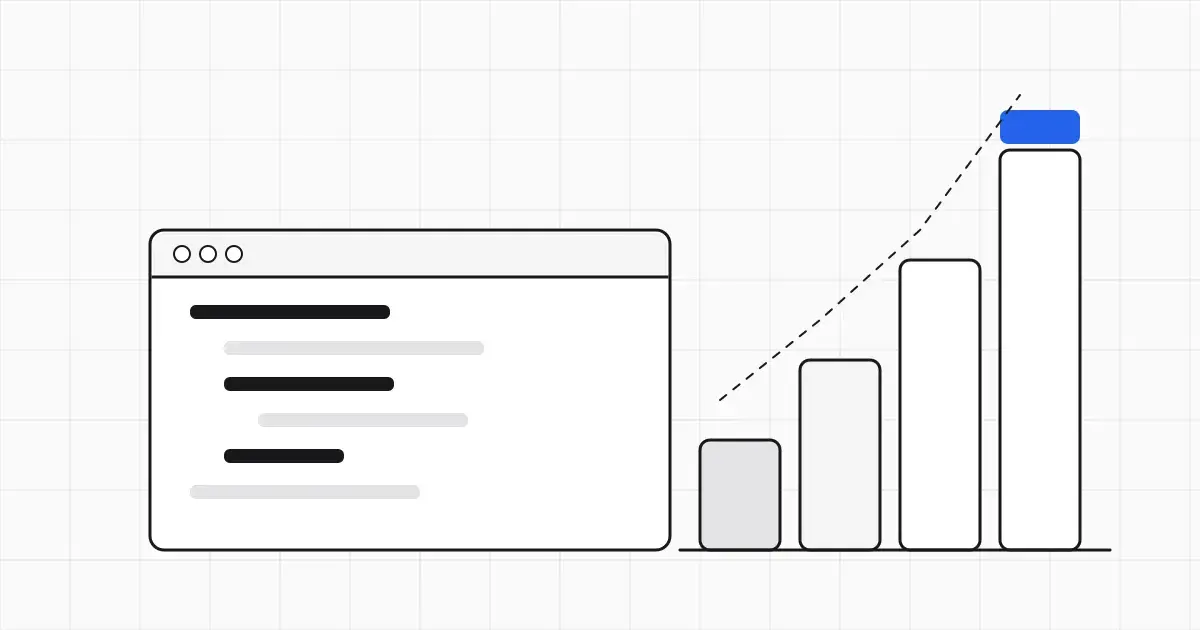
Cursor grew so fast because it removed every reason not to try it: it was a fork of VS Code, so developers kept their editor, extensions and shortcuts, and its AI edits were fast enough to change how they worked on day one. Individual developers adopted it on their own, carried it into their companies, and Cursor then sold to those companies.
The numbers are unusual even by AI standards. Cursor’s own blog went from “exceeded $100m in recurring revenue” in January 2025 to “crossed $1B in annualized revenue” in November 2025, and SpaceX bought the company for $60 billion in stock in August 2026. If you are building an AI product, the useful question is which parts of that were product decisions you can copy and which were timing you can’t.
Download the data
- Cursor revenue timeline (CSV): 16 dated milestones, each with its source URL and a confidence label (company, filing, reported).
- Fastest to $100M ARR (CSV): Lovable, Manus, Cursor, Wiz and Sierra, with the starting line each company used.
- Full dataset (XLSX): both tables plus an implied-growth sheet and a CMGR calculator for your own numbers.
Sources checked on 3 November 2026. “Annualized revenue” here means the latest month times 12, the definition Bloomberg and TechCrunch use. It is not audited revenue.
Cursor’s growth timeline, dated
Cursor announced most milestones in short posts timed to funding rounds. Press filled the gaps. The table separates the two.
| Date | What happened | Annualized revenue | Source type |
|---|---|---|---|
| 2022 | Four MIT students (Michael Truell, Sualeh Asif, Arvid Lunnemark, Aman Sanger) co-found Anysphere | n/a | Press |
| Sep 2023 | $8M seed led by the OpenAI Startup Fund, $11M raised in total | n/a | Cursor blog |
| Apr 2024 | About $4M ARR | ~$4M | Press (sources) |
| Aug 2024 | $60M Series A; “over 40,000 customers” | n/a | Cursor blog |
| Oct 2024 | About $4M a month in revenue | ~$48M | Press (sources) |
| Jan 2025 | $105M Series B; “exceeded $100m in recurring revenue” | $100M+ | Cursor blog |
| Jun 2025 | $900M at a $9.9B valuation; “over $500 million in ARR” | $500M+ | Cursor blog |
| Nov 2025 | $2.3B at $29.3B post-money; “crossed $1B in annualized revenue” | $1B+ | Cursor blog |
| Feb 2026 | Topped $2B; about 60% from corporate buyers | $2B+ | Reported by Bloomberg, via TechCrunch |
| Late Apr 2026 | Hit $3B | $3B | Reported by Bloomberg |
| Early Jun 2026 | Topped $4B | $4B+ | Reported by Forbes |
| 16 Jun 2026 | SpaceX signs merger at a $60.0B implied equity value, all stock | n/a | SEC filing |
| 14 Aug 2026 | Deal closes; holders get 389,289,254 SpaceX Class A shares | n/a | SEC filing |
One caution before you use these numbers in a pitch deck. Announcement dates lag the real milestone, because companies announce at the next funding round. The October 2024 “$4M a month” figure came from TechCrunch’s sources, not Cursor.
The growth rate, worked out
Compound monthly growth rate (CMGR) is the steady monthly rate that turns one number into another: (end ÷ start)^(1 ÷ months) − 1.
- $4M (Apr 2024) to $48M (Oct 2024): 12x in 6 months = about 51% a month.
- $100M (16 Jan 2025) to $500M (6 Jun 2025): 5x in 4.6 months = about 41.5% a month.
- $500M (Jun 2025) to $1B (Nov 2025): 2x in 5.3 months = about 14% a month.
- $1B (Nov 2025) to $2B (Feb 2026): 2x in about 3.5 months = about 22% a month.
That last line is the striking one. Most software companies slow sharply after $1B. Cursor’s monthly rate went back up after it pushed into enterprise. The XLSX has every interval and a calculator for your own figures.
Why Cursor grew so fast: the five moves
1. It forked VS Code instead of asking developers to switch
TechCrunch’s 2023 seed story describes Cursor as “a fork of VS Code, Microsoft’s open source code editor”. That one decision removed the biggest cost of trying a new developer tool: rebuilding your setup. Extensions, themes and keybindings came along. A developer could try Cursor at lunch and keep using it by the afternoon.
A plugin would have been cheaper to build. A fork gave Cursor control of the whole surface, from how edits are shown to how fast they apply. That control is what let the product feel different from autocomplete bolted onto someone else’s editor.
2. It treated speed as the product
The Series A post lists what the team had built in its first year: “next-edit-prediction models, multi-billion-file retrieval systems, and fast code rewrites through speculative inference”. None of that is visible as a feature. All of it is about latency: how quickly a suggestion appears and how quickly a thousand-line change applies.
For an AI product this is a real moat. Anyone can call the same frontier model. Few teams invest in making the loop around the model fast enough that users stop noticing it.
3. It grew bottom-up, then sold top-down
Cursor’s early growth came from individual developers paying for themselves. By June 2025 it said it was used by “over half of the Fortune 500, including NVIDIA, Uber, and Adobe”, and by February 2026 Bloomberg reported about 60% of revenue came from corporate customers.
That sequence matters. Developers brought Cursor into companies before procurement knew about it. When Cursor’s sales team arrived, the usage already existed, so the sale was about consolidating seats, not convincing anyone the product worked.
4. It raised fast, and the raises compounded
Cursor raised five times in about 26 months: $8M seed, $60M Series A, $105M Series B, $900M Series C and $2.3B Series D. Each round was announced alongside a revenue milestone, which made the next round easier to price.
Andreessen Horowitz general partner and Cursor board member Martin Casado told Fortune in March 2026 that “if you subtract out the dollars invested, it’s the fastest-growing company we’ve ever seen”. Read that both ways. Capital funded hiring and model training, and it also subsidized usage while gross margins were negative.
5. It started building its own models before it had to
In January 2025, Cursor said its “proprietary models now generate more code than almost any LLMs in the world”. In November 2025 it launched its own Composer model. TechCrunch’s sources say that model, plus routing to cheaper models such as Moonshot’s Kimi, is what finally pushed Cursor to slight gross margin profitability in 2026.
This is the part AI founders tend to skip. Your model supplier can become your competitor. Anthropic’s Claude Code became Cursor’s main rival, according to TechCrunch. A company paying a competitor for its core input has a pricing problem no amount of growth fixes. Before you scale usage, put your own per-request token costs through the LLM API cost calculator and see what a heavy user really costs you.
What not to copy
Cursor is a survivor story, and survivor stories hide the bodies. Three things worked for Cursor that would sink most startups:
| Cursor did this | Why it worked for Cursor | Why it’s risky for you |
|---|---|---|
| Ran at negative gross margins while growing | Investors priced the growth, not the margin, and kept funding it | Without a $900M round behind you, negative margins are just a slower way to run out of money |
| Depended on a few model suppliers | Growth was fast enough to fund its own models before suppliers squeezed it | Most AI wrappers get squeezed first. Check your own unit cost per user against the cost of running AI coding tools |
| Sold to individuals at low prices | Usage spread inside large companies that later paid enterprise contracts | If your users don’t work at companies that buy software, the bottom-up stage never turns into revenue |
There is also a timing factor no one can copy. Cursor launched as large language models became good enough to write real code, and before GitHub Copilot, Claude Code or OpenAI’s Codex had settled the market.
How Cursor compares with other fast growers
“Fastest to $100M ARR” is a crowded claim, and every company measures from a different starting line. Here are five, each in the company’s own words where possible.
| Company | Months to $100M ARR | Counted from | Source |
|---|---|---|---|
| Lovable | 8 | Public launch, late 2024 | Company, via Tech.eu (Jul 2025) |
| Manus | 8 | Product launch | Company, via Investing.com (Dec 2025) |
| Cursor | ~9 | About $4M ARR (Apr 2024), our calculation | Cursor blog + TechCrunch |
| Wiz | 18 | $1M ARR | Wiz blog (Aug 2022) |
| Sierra | 21 | Commercial launch, Feb 2024 | Sierra blog (Nov 2025) |
Wiz counted from $1M ARR, Sierra from launch, and Cursor never published a figure. So a “Cursor did it in 12 months” claim you see elsewhere isn’t something Cursor said. If you want the full picture of how the newer app builders monetize, see our breakdown of Lovable, Replit and Bolt pricing.
What founders in the US, Canada and Australia can take from it
Four lessons hold up whatever your stage or country:
- Remove switching cost before you add features. Ask what a user must rebuild to try you. Cursor’s answer was nothing.
- Make the core loop fast. In AI products, latency is often the difference between a demo and a habit.
- Plan the enterprise step from day one. Bottom-up adoption is free distribution, but someone still has to sell the contract. Cursor’s revenue mix shifted to about 60% corporate.
- Know your gross margin per user. If it’s negative, write down when and how it turns positive. Cursor’s answer was its own models. Yours might be pricing, caching or a cheaper model tier. Our Cursor plan breakdown shows how Cursor itself repackaged model costs for its users.
On funding: Cursor’s path ran through priced rounds led by US funds, which is easier with a Delaware C-corp. If you’re raising early on SAFEs, read how post-money SAFEs dilute you before you stack several of them, then model the next priced round, pool top-up included, in the option pool calculator.
Who should study Cursor, and who shouldn’t
Study it closely if you’re building a developer or prosumer tool where individuals can adopt you without approval, and where speed is visible to the user.
Don’t model your plan on it if you sell to buyers who need procurement from day one, if you can’t raise large rounds, or if your product is a thin layer on a model you don’t control. The bottom-up, burn-for-growth path works only when both the market and the capital are there. For the opposite playbook, a company that stayed profitable while it grew, read how Canva grew so fast.
This article describes public reporting on a private company. It isn’t investment advice.
Frequently asked questions
How did Cursor grow so fast?
How fast did Cursor grow?
What was Cursor's time to $100M ARR?
Who bought Cursor and for how much?
Was Cursor profitable?
Why is Cursor so popular?
Sources
- 1. Cursor blog: We Raised $8M from OpenAI (1 Sep 2023, archived copy) web.archive.org
- 2. Cursor blog: Series A and Magic (22 Aug 2024) cursor.com
- 3. Cursor blog: Series B and Automating Code (16 Jan 2025) cursor.com
- 4. Cursor blog: Series C and Scale (6 Jun 2025) cursor.com
- 5. Cursor blog: Past, Present, and Future, Series D (13 Nov 2025) cursor.com
- 6. Fortune: Cursor's crossroads (21 Mar 2026) fortune.com
- 7. SpaceX Form 8-K: completion of the Anysphere merger (14 Aug 2026) sec.gov
- 8. TechCrunch: Anysphere raises $8M from OpenAI to build an AI-powered IDE (11 Oct 2023) techcrunch.com
- 9. TechCrunch: Cursor raised another $100M at a $2.6B valuation (19 Dec 2024) techcrunch.com
- 10. TechCrunch: Cursor has reportedly surpassed $2B in annualized revenue (2 Mar 2026) techcrunch.com
- 11. TechCrunch: Cursor in talks to raise $2B+ at $50B valuation (17 Apr 2026) techcrunch.com
- 12. SpaceX Form 8-K: Anysphere merger agreement (16 Jun 2026) sec.gov
- 13. TechCrunch: SpaceX has an option to buy Cursor for $60B (21 Apr 2026) techcrunch.com
- 14. Bloomberg: Cursor hits $3 billion annual sales rate (21 May 2026) bloomberg.com
- 15. Forbes: Cursor hits $4 billion annualized revenue (8 Jun 2026) forbes.com
- 16. Wiz blog: $100M ARR in 18 months (10 Aug 2022) wiz.io
Founder, unboxth
Saksham Dogra is the founder of unboxth. He writes founder to founder about building an AI startup from anywhere: company setup, costs, tools and fundraising.