Corporate Minute Book Template Canada: Free OBCA/CBCA Kit
Kit sellers charge for a binder of blank forms. This one is free, cites the section of each Act behind every tab, and covers federal, Ontario and BC corporations.
Saksham Dogra 9 min read
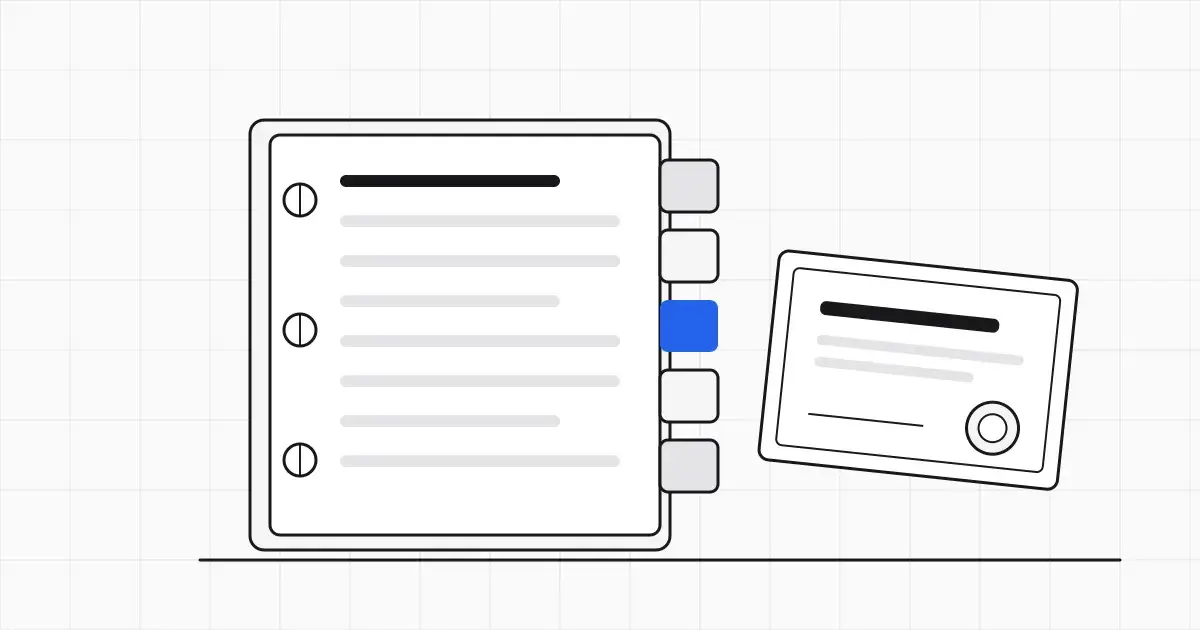
A corporate minute book template for Canada is a ready-made set of the records your corporate statute requires: organizational resolutions, director and shareholder resolutions, a securities register, director records, an individuals with significant control (ISC) register and a share certificate. Download ours free as an editable DOCX, built for federal (CBCA), Ontario (OBCA) and BC corporations, with a one-page checklist of what each Act requires.
It matters more than it looks. A federal corporation that fails, without reasonable cause, to keep its ISC register can be fined up to $100,000 (CBCA s. 21.1(6)). And the first thing a seed investor’s lawyer asks for in due diligence is the minute book.
Download the kit
- Download the corporate minute book template (DOCX): 13 tabs, every field in [BRACKETS], shaded notes that cite the section behind each record, and federal, Ontario and BC wording side by side.
- Download the one-page minute book checklist (PDF): what each Act requires and where it must be kept, in one table.
Statutes checked on 4 Nov 2026 against the official consolidations (Justice Laws, Ontario e-Laws and BC Laws). Sample, not legal advice.
What goes in a minute book, by statute
The three Acts ask for the same core records but number and name them differently. This is the table the kit is built on.
| Record | CBCA (federal) | OBCA (Ontario) | BC BCA |
|---|---|---|---|
| Articles, by-laws, amendments, unanimous shareholder agreement | s. 20(1)(a) | s. 140(1)(a) | s. 42(1)(a), (2)(a) (articles, certificate, incorporation agreement) |
| Shareholder minutes and resolutions | s. 20(1)(b) | s. 140(1)(b) | s. 42(1)(i) to (k) |
| Director minutes and resolutions | s. 20(2) | s. 140(2)(b) | s. 42(1)(l) to (n) |
| Directors | Copies of notices sent under ss. 106 and 113, s. 20(1)(c) | Register of directors with residence addresses and dates, s. 140(1)(c) | Register of directors, consents to act, resignations, s. 42(1)(e) to (g) |
| Securities register | s. 20(1)(d), complying with s. 50 | s. 140(1)(d) and s. 141, plus a register of transfers, s. 141(2) | Central securities register, s. 42(1)(d) |
| Beneficial ownership | ISC register, s. 21.1 | ISC register, s. 140(1)(f) and s. 140.2 | Transparency register, s. 119.2 |
| Land | None | Register of interests in Ontario land, s. 140.1 | None |
| Accounting records | s. 20(2), kept 6 years, s. 20(2.1) | s. 140(2)(a), 6 years once tax rules are met | Financial statements, s. 42(1)(p) |
| Where | Registered office or another place in Canada the directors designate, s. 20(1) | Registered office or another place in Ontario the directors designate, s. 140(1) | Records office in BC, s. 42(1); electronic access allowed, s. 43(2) |
Sources: CBCA ss. 19 to 21.1, OBCA, BC BCA Part 2 and Part 4.1, checked on 4 Nov 2026.
Three details founders miss:
- Ontario’s securities register is specific. It lists holders alphabetically, includes everyone registered within the last six years with their street address (and e-mail if provided), and records the date and particulars of each issue (OBCA s. 141(1)). A cap table spreadsheet doesn’t meet that on its own.
- Federal records can live in the cloud, with a condition. The CBCA lets you keep records outside Canada if they can be inspected from the registered office or another place in Canada by computer, and you provide the technical help to do it (s. 20(5.1)).
- The CRA’s rule is different. For tax records, the CRA says records kept outside Canada and accessed electronically from Canada “are not considered to be records kept in Canada,” so you need its written permission (CRA). Keep the books and the accounting records in Canada unless you’ve sorted that out.
What’s in the kit
| Tab | What it is | When you use it |
|---|---|---|
| 1 | Articles and certificate, plus a filings log | On incorporation and every amendment |
| 2 | By-law No. 1 placeholder | Once; a lawyer should draft or review it |
| 3 | Organizational resolutions of the directors (by-law, officers, founder share issue, banking, year end, records location, ISC register) | Signed as of the incorporation date |
| 4 | Organizational resolutions of the shareholders (confirm by-law, elect directors, auditor or audit exemption) | Same day |
| 5, 6 | Registers of directors and officers | Every appointment or resignation |
| 7 | Securities register and register of transfers | Every issue or transfer of shares |
| 8 | ISC register (BC: transparency register) with an annual review log | On incorporation, at least yearly, within 15 or 30 days of any change |
| 9 | Share certificate and certificate stubs | Every issue |
| 10, 11 | Annual resolutions of directors and shareholders, plus a compliance log | Every year after the financial statements are ready |
| 12, 13 | Consent to act, resignation, notices log; unanimous shareholder agreement | As they happen |
The by-law is deliberately a placeholder. It has to match your articles, share structure and Act, and a generic one is where DIY kits cause real problems. BC companies keep their rules in the articles instead, so they can leave Tab 2 empty.
How to use the kit, step by step
- File the incorporation documents in Tab 1. Certificate, articles (BC: incorporation application, notice of articles and the signed incorporation agreement).
- Delete the other statutes’ wording. Search the DOCX for “[CBCA”, “[OBCA” and “[BC BCA” and keep only yours.
- Get the by-law done. Federal and Ontario corporations need a general by-law; put it in Tab 2.
- Sign the directors’ organizational resolutions (Tab 3), then the shareholders’ (Tab 4), dated the incorporation date. Written resolutions signed by every director or shareholder are how most small corporations act.
- Issue share certificates (Tab 9) that match Resolution 3 exactly: holder, class, number, date.
- Fill the registers (Tabs 5 to 8) from those resolutions. The ISC register gets the date of birth, address, tax residence and the reason each person qualifies.
- Diarize the annual cycle: financial statements, annual resolutions (Tabs 10 and 11), ISC review, annual return.
- Delete the shaded notes from the signed copies. Keep the unsigned DOCX as your template.
Worked example: two founders, one federal corporation
Maya (Toronto) and Dev (Vancouver) incorporate Northline AI Inc. under the CBCA on 2 February 2027, with Ontario as the registered office province. Their December 31 year end is set in the directors’ resolution.
- Shares. The directors issue 5,000,000 common shares to Maya and 3,000,000 to Dev at CAD 0.0001 each. Maya pays CAD 500 (5,000,000 × 0.0001) and Dev pays CAD 300. Total issued: 8,000,000 shares.
- ISC test. Maya holds 5,000,000 ÷ 8,000,000 = 62.5%. Dev holds 37.5%. Both are above 25%, so both go in the ISC register on 2 February 2027 (CBCA s. 2.1(3)).
- An angel joins. In June they issue 2,000,000 shares to an angel investor at CAD 0.25, raising CAD 500,000 (2,000,000 × 0.25). There are now 10,000,000 shares. The angel holds 20%: not an ISC on shares alone. Maya drops to 50% and Dev to 30%, both still ISCs. The register records the change within 15 days of the issue (s. 21.1(3)).
- Records to update that week: a directors’ resolution approving the issue, a new certificate and stub, the securities register, the ISC register (new percentages and a dated step in the review log), and the shareholder agreement if they signed one.
Figures are illustrative; the 25% test and the 15-day rule are statutory.
The ISC register: the rules in one place
| Rule | CBCA | OBCA | BC BCA |
|---|---|---|---|
| Who is in it | 25% of votes or 25% of shares by FMV, or control in fact, s. 2.1 | Same test, s. 1.1 | 25% of shares or votes, or power to elect or remove a majority of directors, s. 119.11 |
| Information | Name, date of birth, residential address, address for service if given, citizenship, tax residence, dates, how they qualify, steps taken, s. 21.1(1) | Name, date of birth, latest known address, tax residence, dates, how they qualify, steps taken, s. 140.2(1) | Name, date of birth, last known address, citizenship or permanent residence, tax residence, dates, how they qualify, s. 119.2(2) |
| Review | At least once each financial year, s. 21.1(2) | At least once each financial year, s. 140.2(3) | Annually, within 2 months after the incorporation anniversary, s. 119.3 |
| Record changes | Within 15 days, s. 21.1(3) | Within 15 days, s. 140.2(4) | Within 30 days, s. 119.31 |
| Delete former ISC data | Within 1 year after the 6th anniversary of ceasing, s. 21.1(5) | Same, s. 140.2(6) | Same window, s. 119.4 |
| Penalty | Corporation up to $100,000, s. 21.1(6) | Corporation up to $5,000; director who knowingly permits up to $200,000 or 6 months, s. 258.1 | Not covered here |
Shareholders have to answer the corporation’s request for this information (CBCA s. 21.1(4); OBCA s. 140.2(5); BC s. 119.21). If nobody meets the test, say so in the register and log the steps you took; BC requires a statement to that effect (s. 119.2(3)). Ontario’s ISC register is also excluded from the records shareholders and creditors may inspect (OBCA s. 145(1)), and BC limits inspection to directors and listed officials (s. 119.61).
What happens to the minute book after a Delaware flip
A “flip” puts a new parent company, usually a Delaware corporation, on top of your Canadian one. YC describes the usual result: “Often, the original entity will become a subsidiary of a new parent company and will continue to operate in the startup’s home country” (YC). Note that YC itself invests in Canadian corporations, so a Canadian company doesn’t need to flip for YC; some US investors still ask for one.
If the Canadian corporation survives as a subsidiary, its Act still applies, so its minute book keeps going. In practice:
- The securities register changes owners. The parent becomes the registered shareholder, and every founder’s transfer or exchange goes in the register of transfers.
- The ISC register still matters. The parent is a company, not an individual, but the founders who control the parent can still have indirect control or direction over the Canadian shares. Work out with your lawyer who stays on the register and log the analysis as a step.
- The new parent keeps its own records under its own law. Keep them separate from the Canadian book.
The tax side of a flip (rollovers, CCPC status, the new parent’s QSBS position) is beyond this page; see C-corp vs LLC for a startup and get advice on both sides of the border.
Who should use this kit, and who shouldn’t
| Use it if | Don’t rely on it alone if |
|---|---|
| You’re a private CBCA, OBCA or BC corporation with common shares only | You have preferred shares, share classes with special rights, or an option plan |
| You have one to a few founders and no outside investors yet | You’re closing a priced round, a flip or an amalgamation |
| Your lawyer drafted the by-law but you keep the books yourself | You’re incorporated in Alberta, Quebec or another province: the record lists differ |
| You want to rebuild a book that was never kept | Records are missing for years and a deal depends on them (BC lets a court rule on missing records under s. 45; elsewhere, talk to a lawyer) |
Mistakes we see in founder minute books
- A cap table but no securities register. Investors’ counsel wants the statutory register and the resolutions behind each issue, not just a spreadsheet.
- No ISC register at all. Section 21.1 was added to the CBCA by a 2018 amendment (S.C. 2018, c. 27), and Ontario’s s. 140.2 has been in force since 1 January 2023, per the amendment notes on each Act.
- Shares issued before the price was paid. The resolution should record that the consideration was received.
- Records kept in a founder’s US Google Drive with no plan. Check both the corporate rule (s. 20(5.1) for federal) and the CRA’s rule for tax records.
- Forgetting the minute book after a flip. The Canadian subsidiary still needs its annual resolutions and registers.
Running a US LLC from Canada instead? Read US LLC for Canadians and the T1134 guide. More guides live in the Founder Playbooks hub.
This page and the downloads are general information and a sample, not legal or tax advice. Statutes were checked on 4 Nov 2026 and can change. Have a Canadian corporate lawyer review your by-law, share terms and any reorganization.
Frequently asked questions
What should be in a corporate minute book in Canada?
Is there a free corporate minute book template for Ontario?
Can a minute book be kept digitally?
Who has to be in the individuals with significant control register?
How long do you have to keep a corporate minute book?
Do I need a lawyer to set up a minute book?
Sources
- 1. Canada Business Corporations Act, ss. 2.1 to 14 (Justice Laws, current to 2026-10-19) laws-lois.justice.gc.ca
- 2. Canada Business Corporations Act, ss. 15 to 21.1, Registered Office and Records (Justice Laws) laws-lois.justice.gc.ca
- 3. Business Corporations Act (Ontario), R.S.O. 1990, c. B.16 (ss. 1.1, 140, 140.1, 140.2, 141, 144, 258.1) ontario.ca
- 4. Business Corporations Act (BC), Part 2, Division 5, Company Records (ss. 42 to 46) bclaws.gov.bc.ca
- 5. Business Corporations Act (BC), Part 4.1, Transparency Register (ss. 119.1 to 119.91) bclaws.gov.bc.ca
- 6. CRA: Where to keep your records, for how long and how to request the permission to destroy them early canada.ca
- 7. Y Combinator: The Y Combinator Deal (Incorporating) ycombinator.com
Founder, unboxth
Saksham Dogra is the founder of unboxth. He writes founder to founder about building an AI startup from anywhere: company setup, costs, tools and fundraising.